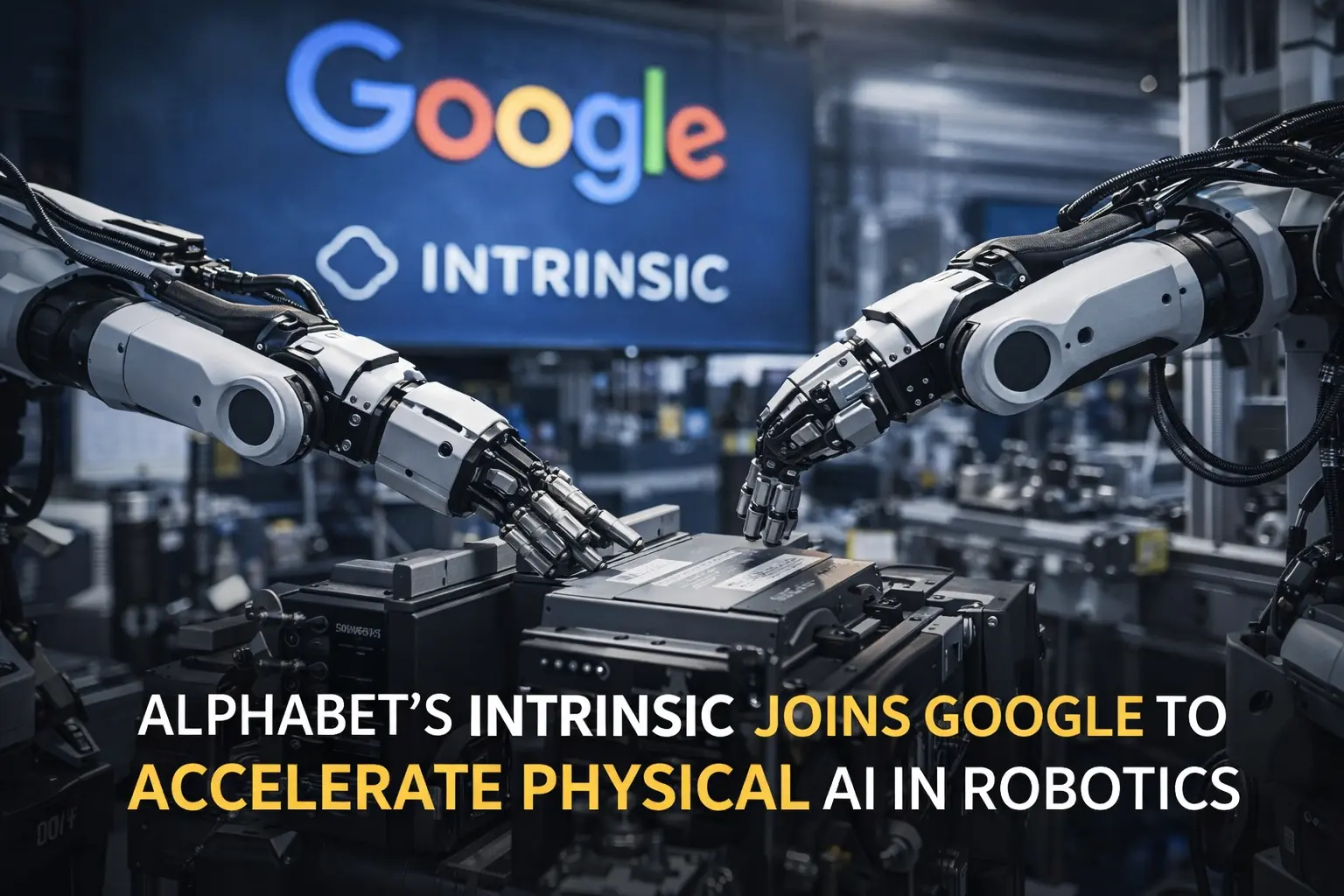
Alphabet’s Intrinsic Joins Google to Accelerate Physical AI in Robotics
In a significant development for the robotics and artificial intelligence industry, Intrinsic — a robotics software company originally incubated within Alphabet’s X division — is officially joining Google to advance the development of physical AI systems in robotics. The move signals Google’s growing commitment to bringing advanced AI capabilities into real-world industrial and automation environments.
From Moonshot Project to Google Integration
Intrinsic was launched from Alphabet’s X “moonshot factory” as an ambitious effort to simplify robotics software and make industrial automation more accessible. In 2021, it spun out as an independent company focused on developing tools that help engineers design, program, and deploy intelligent robotic systems more easily.
Now, by integrating with Google, Intrinsic’s robotics software platform will align more closely with Google’s broader artificial intelligence ecosystem, including cloud computing, machine learning models, and AI research initiatives.
What Is Physical AI?
Physical AI refers to artificial intelligence systems that operate in the physical world through machines and robots. Unlike purely digital AI systems that function within software applications, physical AI allows robots to perceive environments, interpret sensor data, make decisions, and execute complex physical actions.
Traditional industrial robots rely heavily on fixed programming and repetitive task automation. Physical AI aims to enable robots to adapt to dynamic environments, adjust to variability, and perform tasks that previously required human flexibility and reasoning.
How Intrinsic Strengthens Google’s Robotics Vision
Intrinsic developed a robotics software platform designed to reduce the complexity of robot programming. Its tools allow developers to build robotic workflows across different hardware systems without writing highly specialized low-level code for each device.
By joining Google, Intrinsic gains access to:
- Advanced AI reasoning models
- Cloud-based machine learning infrastructure
- Large-scale data processing capabilities
- AI perception and vision technologies
This integration is expected to help accelerate the transition from research-level robotics experiments to scalable industrial deployments.
Impact on Manufacturing and Industrial Automation
The manufacturing industry is increasingly seeking more flexible automation systems. Traditional robots are powerful but often rigid in functionality and expensive to reprogram for new tasks. AI-enhanced robotics platforms promise greater adaptability and cost efficiency.
With Google’s AI capabilities combined with Intrinsic’s robotics software tools, manufacturers may gain access to smarter automation systems capable of:
- Adapting to changing production environments
- Handling variable objects and workflows
- Improving safety through intelligent monitoring
- Reducing engineering setup time
This could lower the barrier to entry for small and mid-sized manufacturers seeking to adopt advanced robotics solutions.
Leadership Perspective
Intrinsic’s leadership emphasized that joining Google will allow the company to expand its reach and accelerate innovation in intelligent robotics systems. The goal is to make robotics more accessible to developers and businesses by simplifying deployment and enhancing AI integration.
Google’s AI teams, including those working on large language models and perception systems, are expected to collaborate closely with Intrinsic’s robotics experts to push forward the next generation of embodied artificial intelligence.
The Growing Race in Physical AI
Major technology companies are increasingly investing in robotics as AI models mature. Physical AI is emerging as the next frontier after breakthroughs in generative AI and digital assistants. Companies worldwide are racing to build systems where intelligence is not just conversational but capable of interacting with and manipulating the physical world.
Google’s integration of Intrinsic demonstrates that large-scale AI companies see robotics as a strategic long-term opportunity rather than a niche experiment.
Future Outlook
While the integration is still in its early stages, industry analysts expect continued development in AI-driven robotics platforms over the coming years. As machine learning models become more capable and robotics hardware becomes more advanced, the line between digital AI systems and physical automation will continue to blur.
The collaboration between Intrinsic and Google could play a pivotal role in shaping the future of smart factories, logistics automation, and intelligent robotic systems that operate safely and efficiently alongside humans.
Conclusion
Intrinsic joining Google marks a major step forward in the advancement of physical AI in robotics. By combining robotics software expertise with powerful AI infrastructure, the partnership aims to accelerate innovation in industrial automation and embodied intelligence.
As artificial intelligence continues evolving beyond digital environments, the integration of AI into physical systems may define the next era of technological transformation across industries worldwide.
Source: The Robot Report coverage on Intrinsic joining Google to advance physical AI in robotics.