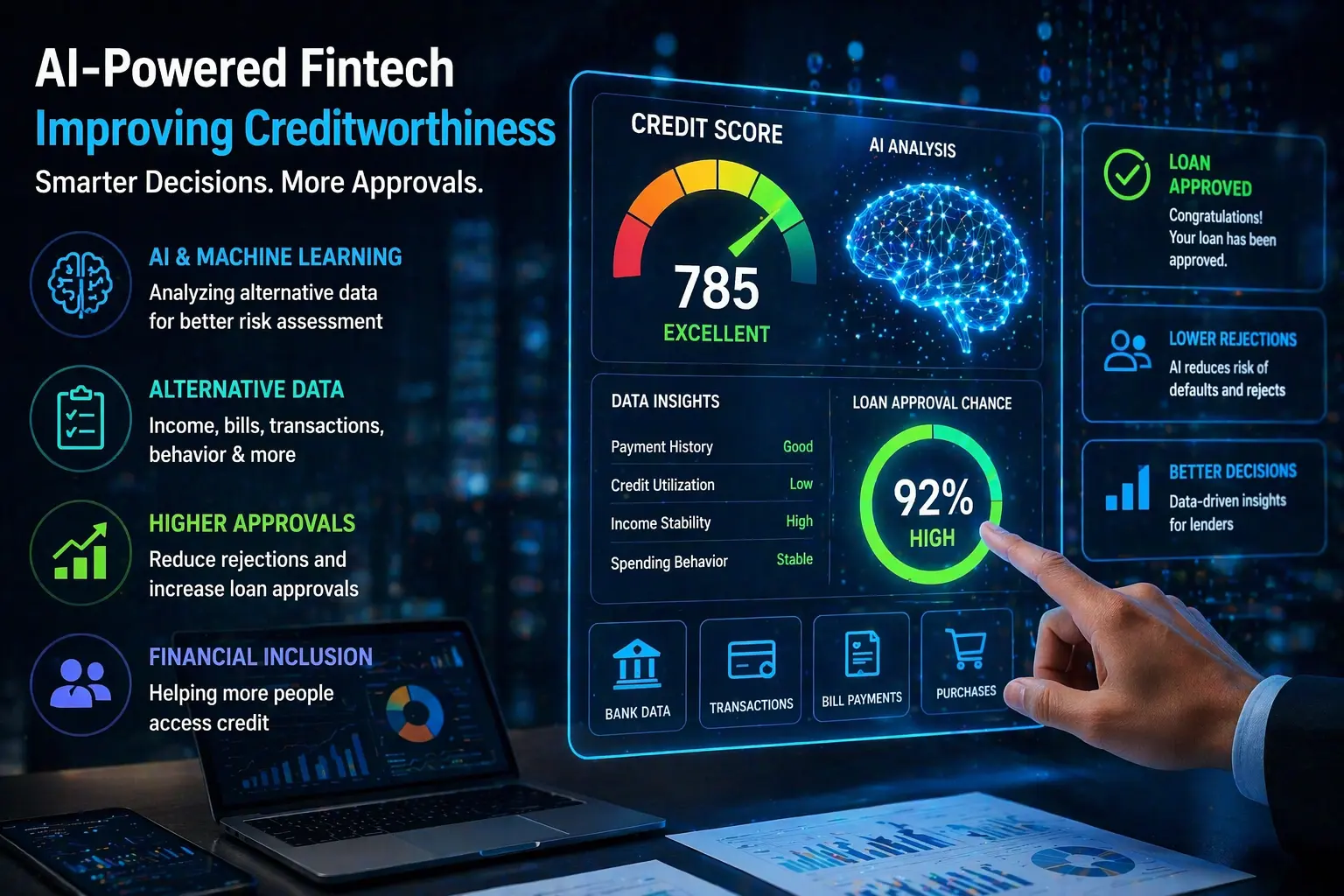
🚀 Fintech Companies Use AI to Improve Creditworthiness and Reduce Loan Rejections
🚀 Introduction
The financial industry is undergoing a major transformation as fintech companies increasingly adopt artificial intelligence (AI) to improve creditworthiness and reduce loan rejections. Traditional credit systems often fail to accurately assess individuals who lack a formal credit history, leading to high rejection rates.
With the introduction of AI-driven solutions, fintech startups are now able to analyze a broader range of data points, enabling more accurate credit evaluations and expanding access to financial services.
📌 Key Highlights
- Fintech companies using AI for credit evaluation
- AI analyzes alternative data sources
- Reduction in loan rejection rates
- Improved financial inclusion
- Better risk assessment for lenders
📰 What is Happening in Fintech?
Fintech startups are moving beyond traditional credit scoring methods and leveraging AI to create more comprehensive borrower profiles. These systems analyze user behavior, transaction history, and alternative data to determine creditworthiness.
This approach allows lenders to make more informed decisions and approve loans for individuals who would otherwise be rejected.
🤖 How AI Improves Creditworthiness
AI systems use advanced algorithms and machine learning models to evaluate financial data. These systems can process large volumes of information and identify patterns that humans might miss.
- Analyzes spending behavior
- Evaluates income patterns
- Studies transaction history
- Uses alternative data sources
This enables a more accurate assessment of a borrower’s ability to repay loans.
💡 Role of Alternative Data
One of the key advantages of AI in fintech is the use of alternative data. Traditional credit systems rely heavily on credit scores, which may not be available for many individuals.
AI systems, on the other hand, can analyze:
- Mobile usage data
- Utility bill payments
- Online transactions
- Behavioral patterns
This helps create a more complete financial profile.
📊 Impact on Loan Approvals
The use of AI in credit evaluation has significantly improved loan approval rates. Studies show that a majority of lenders have experienced higher approval rates after adopting AI and machine learning technologies.
This not only benefits borrowers but also helps lenders expand their customer base.
🏦 Benefits for Financial Institutions
- Better risk assessment
- Reduced default rates
- Faster loan processing
- Improved customer experience
These advantages make AI a valuable tool for modern financial institutions.
🌍 Financial Inclusion
AI-driven credit systems play a crucial role in promoting financial inclusion. Many individuals, especially in developing countries, lack access to formal banking services.
By using alternative data, fintech companies can provide credit to underserved populations.
⚠️ Challenges and Risks
Despite its benefits, AI in fintech also presents challenges:
- Data privacy concerns
- Algorithmic bias
- Lack of transparency
- Regulatory challenges
It is important for companies to address these issues to ensure responsible AI usage.
📊 Future of AI in Fintech
The future of fintech is closely tied to artificial intelligence. As technology continues to evolve, AI will become an integral part of financial decision-making.
We can expect:
- More accurate credit scoring
- Fully automated lending systems
- Improved financial accessibility
- Global adoption of AI-driven finance
💡 Expert Insights
Experts believe that AI will revolutionize the financial industry by making credit more accessible and reducing inefficiencies in traditional systems.
🔗 Conclusion
The adoption of AI in fintech is transforming how creditworthiness is assessed and loans are approved. By leveraging advanced data analysis and machine learning, fintech companies are creating a more inclusive and efficient financial system.
As AI continues to evolve, its impact on the financial sector will only grow, shaping the future of digital lending.