🚀 Indian-Origin Scientist Vandi Verma Leads NASA’s First AI-Planned Drive on Mars
Keywords: NASA News, AI in Space, Mars Rover, Vandi Verma, Robotics, Artificial Intelligence
🚀 Introduction
NASA has achieved a historic milestone in space exploration by successfully executing the first-ever artificial intelligence (AI)-planned drive on Mars. This breakthrough marks a new era in robotic exploration, where machines are capable of making decisions independently without constant human control.
At the heart of this innovation is Vandi Verma, an Indian-origin scientist and robotics expert at NASA’s Jet Propulsion Laboratory (JPL). Her contributions have played a key role in making Mars exploration smarter and more autonomous.
📌 Key Highlights
- NASA completed first AI-planned rover drive on Mars
- Perseverance rover used AI to navigate terrain
- Indian-origin scientist Vandi Verma played a major role
- AI reduces dependency on human control
- This marks a new era in space robotics
📰 What Happened on Mars?
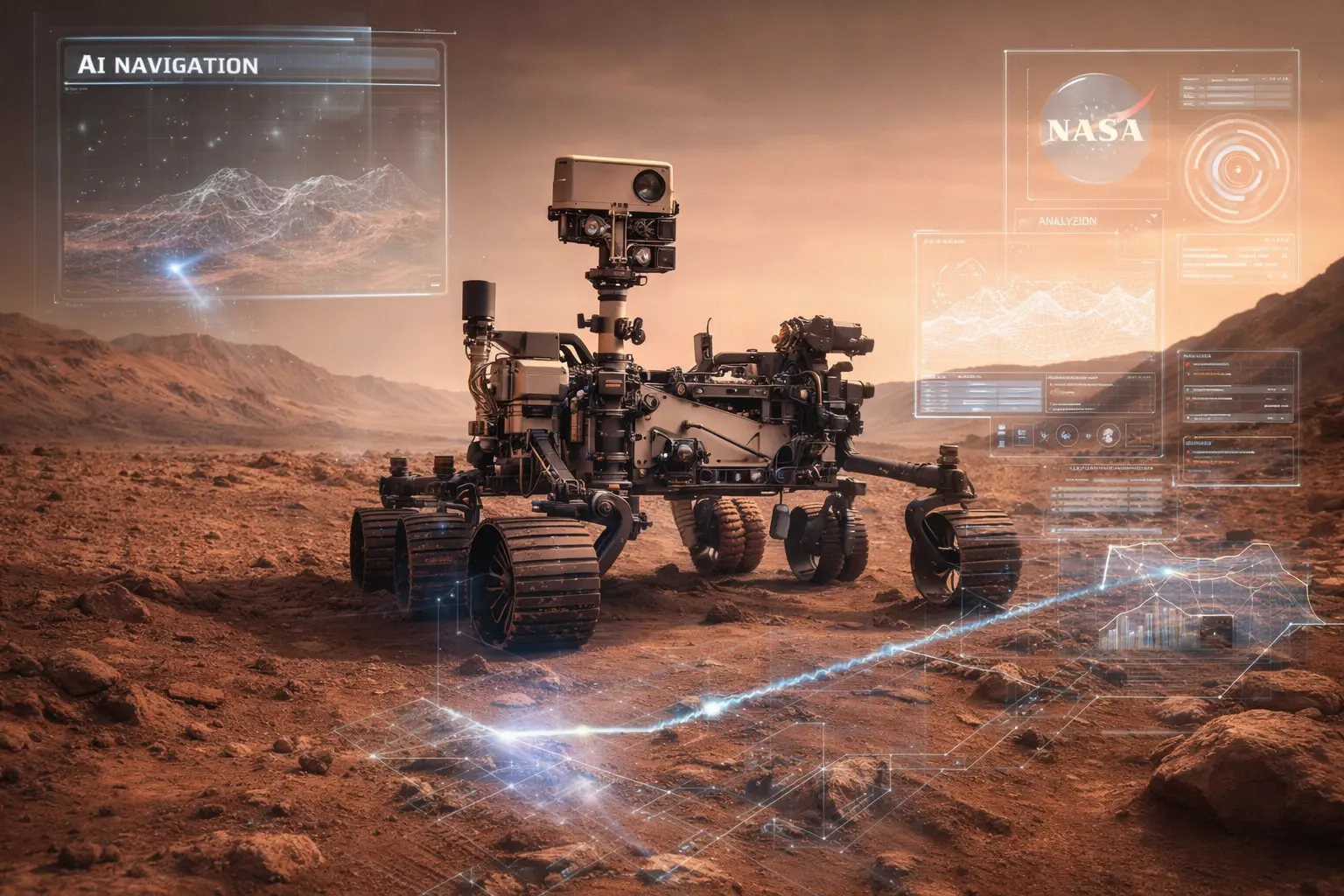
In December 2025, NASA’s Perseverance rover performed a fully AI-driven navigation on the Martian surface. Unlike traditional missions where engineers plan every move from Earth, this time the rover used artificial intelligence to decide its own path.
Due to the long distance between Earth and Mars, communication delays can range from 5 to 20 minutes. This makes real-time control impossible. AI solves this problem by allowing the rover to make decisions on its own.
🤖 How AI Technology Works
The AI system uses advanced computer vision and machine learning algorithms to analyze images of the Martian terrain. It identifies obstacles such as rocks, slopes, and uneven surfaces.
- Real-time terrain analysis
- Obstacle detection
- Route optimization
- Autonomous decision-making
This enables the rover to move safely and efficiently without human intervention.
👩🚀 Who is Vandi Verma?
Vandi Verma is a leading robotics engineer at NASA’s Jet Propulsion Laboratory. She has played a significant role in multiple Mars missions and is known for her expertise in robotic operations.
Originally from India, she completed her education in engineering before moving to the United States to pursue advanced studies in robotics.
🏫 Education and Career
Vandi Verma studied electrical engineering at Punjab Engineering College in Chandigarh. She later specialized in robotics and joined NASA, where she contributed to major missions like Spirit, Opportunity, Curiosity, and Perseverance rovers.
🚀 Her Role in NASA Missions
At NASA, she works on developing systems that allow robots to operate independently in extreme conditions. Her work focuses on autonomy, navigation, and robotic intelligence.
She has been instrumental in advancing AI-based navigation systems that are now being used on Mars.
🌌 Why This Achievement Matters
This achievement is a major step forward in space exploration. It reduces the need for human intervention and allows missions to operate more efficiently.
- Faster decision-making
- Reduced communication delays
- Improved mission efficiency
- Lower operational costs
📊 Future of AI in Space
AI will play a crucial role in future missions, including Mars colonization and deep space exploration. Robots will be able to explore distant planets and conduct research independently.
This technology will help scientists gather more data and make new discoveries about the universe.
💡 Expert Insights
Experts believe that AI-driven robotics will revolutionize space exploration. It will enable missions that were previously impossible due to technical limitations.
The success of this experiment shows that autonomous systems are the future of space technology.
🔗 Conclusion
NASA’s AI-planned drive on Mars is a groundbreaking achievement that demonstrates the power of artificial intelligence in space exploration. With scientists like Vandi Verma leading innovation, the future of robotics and AI looks incredibly promising.
This milestone brings us one step closer to fully autonomous space missions and deeper exploration of the universe.
📢 Tags
NASA, Mars Rover, AI Technology, Vandi Verma, Space Exploration, Robotics, Artificial Intelligence